Despite the fact that piranha's - undeservedly so - have a bad
reputation of being mindless, bloodthirsty killers, they are quite popular
'pets' and an ever increasing of people keep them at home in their aquariums.
And it must be said: piranha's, being tough and hardy fish, are by far not the
most difficult or even dangerous fish to take care of, as long as you take note
of a few simple basic rules, which will be outlined on this page.
The most common species, which most of us have seen in either in a pet store,
public aquarium or zoo, is the Redbellied piranha (Pygocentrus nattereri).
Somewhat paradoxically, this species is one of the few members of the piranha
family which is considered potentially dangerous to men (together with the in
the aquarium trade much more rare Pygocentrus cariba and Pygocentrus
piraya - these are the three species of 'True' Piranha's, that in the wild
live in huge shoals of often hundreds of fish). Other fairly widespread species
are the Pacu's (genus Colossoma), Silver Dollars (genera Metynnis, Myleus and
Mylossoma), the Rhombeus Piranha (Serrasalmus rhombeus) and the
Maculatus Piranha (Serrasalmus maculatus). With exception of the latter
two, these fish are predominantly herbivorous (ie. plant eaters), but for that
very reason many consider them to be not as attractive or desirable as their
infamous carnivorous relatives.
Something that many people don't realize is that many species can grow to
pretty large sizes, especially when one compares them with popular and more
known freshwater community fish such as Tetras, Barbs, Apistogramma Cichlids or
Corydoras Catfish. This gap in knowledge is further complicated by the fact
that many of the piranha's sold in stores are little, if at all, larger than
those fish, in combination with a lack of proper education and preparation by
the selling party.
And that can pose rather obvious, but to the owners often overlooked problems,
problems that in usually go at the expense of the fish: most species can reach
a size of at least 8-10", but the largest species (Pygocentrus piraya
and Serrasalmus manueli) may grow up to as much 2 feet, so a very large
tank is an absolute necessity regardless of what species you intend to keep!
The exact size of the tank piranha's should be kept depends on the species, and
often is a matter of heated debate amongst piranha enthousiasts. A common rule
of thumb is at least 20 gallon (80 liter) per adult fish for Pygocentrus
species, and for the smaller solitary Serrasalmus species at least a 40-48"
(100-120cm.) long tank. All Pygocentrus species are shoaling fish by nature,
which means that they should be kept with more than one in a tank. Most
experienced keepers of shoaling species will confirm that a single Pygocentrus
will not be a lot of fun, not only because it is likely to remain shy and
reclusive throughout its entire life and will hide all day except during
feeding time, but also because it will show little to no natural behavior
whatsoever. Two fish will also result in failure most of the time, because
eventually they will turn against each other trying to establish dominance, and
will often fight until one is killed. Even though there are exceptions to this,
most piranha keepers will recommend three or more Pygocentrus. But there are no
iron laws when it comes to keeping piranha's, which is demonstrated by various
reports from Pygocentrus-owners: some recommend far more than 100 liters per
fish, and others keep 8 or 10 healthy adult Redbellies in a 100 gallon (400
liter) tank... Important to remember is this: if your tank is cramped, you can
expect stressed and unhealthy fish, and probably some casualties as well, due
to disease and stress, aggression and territorial disputes. The more tank space
your fish will have, the more comfortable and lively they will be. And
piranha's, no matter what size or species, look best in a very large and
natural looking tank to begin with.
Serrasalmus piranha's are a different story: most species must be kept
solitary, because they are very aggressive and intolerant and will most likely
kill every other fish that enters their tank, whether from the same species or
not. Some will even attack their keeper when (s)he approaches the tank, their
own reflection and even aquarium hardware inside the tank (heaters, powerheads!)
in not always safe. A few species have been kept with more than one, like the
Maculatus Piranha, Spilopleura Piranha and Geryi Piranha, but there is no
guarantee it will work out: a very large tank, enough hiding places and a very
strict feeding regime are an absolute necessity to even have a chance to
succeed.
Minimum tank size recommendations for the most
wide-spread piranha species
Recommendations only! These fish can live in less spaceous
tanks, but this is what I believe to be the minimum space to keep them
healthy.
|
True Piranha's (Pygocentrus)
|
|
Pygocentrus cariba
|
- Juveniles (<
3"): ± 10-15 gallons per fish
- Sub-adults (3-6"): 15-25 gallons per fish
- Adults (6" and more): 25+ gallons per fish
|
|
Pygocentrus nattereri - tankraised
|
- Juveniles (<
3"): 8-10 gallons per fish
- Sub-adults (3-6"): 10-20 gallons per fish
- Adults (6" and above): 20+ gallons per fish
|
|
Pygocentrus nattereri - wildcaught
|
- Juveniles (<
3"): ± 10-15 gallons per fish
- Sub-adults (3-6"): 15-25 gallons per fish
- Adults (6" and more): 25+ gallons per fish
|
|
Pygocentrus piraya
|
- Juveniles (<
3"): ± 10-15 gallons per fish
- Sub-adults (3-6"): 15-25 gallons per fish
- Adults (6-12" and above): 25-40 gallons per fish
- Full-grown fish (12" and above): at least 40 gallons per fish
|
|
Pirambeba's (Serrasalmus, Pygopristis,
Pristobrycon)
|
|
|
Pygopristis denticulata
Serrasalmus irritans
Serrasalmus medinai
Serrasalmus sanchezi
|
- Juveniles (<
3"): ± 15-25 gallons (at least 24x16")
- Sub-adults (3-6"): 25-40 gallons (at least 32x14")
- Adults (6" and more): 40+ gallons (at least 40x16")
|
|
Serrasalmus altuvei
Serrasalmus brandtii
Serrasalmus compressus
Serrasalmus eigenmanni
Serrasalmus geryi
Serrasalmus maculatus
Serrasalmus
spilopleura
|
- Juveniles (<
3"): ± 15-30 gallons (at least 24x12")
- Sub-adults (3-6"): 30-50 gallons (at least 32x16")
- Adults (6" and more): 50+ gallons (at least 48x18")
|
|
Serrasalmus elongatus
|
- Juveniles (<
3"): not available
- Sub-adults (3-6"): 45-65 gallons (at least 40x18")
- Adults (6" and above): 65 gallons and above (at least 48x20")
|
|
Serrasalmus manueli
Serrasalmus rhombeus
|
- Juveniles (<
3"): 25-40 gallons (at least 32x14")
- Sub-adults (3-8"): 40-65 gallons (at least 40x16")
- Adults (8-12"): 65-100 gallons (at least 48x20")
- Full-grown fish (12" and above): 100 gallons and above (at least
60x20")
|
|
Buying and selecting your piranha's
Before starting with piranha's as pets, you should think about
the reasons why you want to take of them. If the sole reason for keeping
piranha's is their legendary reputation of being bloodthirsty and ruthless
killers, you for sure will be very disappointed. In reality, piranha's are
nervous, shy and easy to frighten animals, and they will never be able to live
up to their reputation in a home aquarium. In short, if carnage and the
massacre of feeder animals are the main reasons for getting piranha's: don't
buy piranha's !!! Some people say that after goldfish, piranha's are the
most abused aquatic pets, and, after hearing many stories from disappointed
piranha keepers, unfortunately there is no denying this.
If, on the other hand, you decide to keep piranha's because you want to learn
about them, observe them, and appreciate them for what they really are, you
will not regret it. Piranha's are very fascinating animals with many surprising
aspects and full of personality, even though they are not what most people
think they are.... I admit, it is very entertaining and impressive to see
piranha's feed (especially on live animals), but if that would be the only
reason for getting them, do yourself a favor, and don't!
When you are prepared to give piranha's the care and attention they need (and
deserve), the first step will be selecting the piranha's you want. Before
purchasing them, however, be sure your newly set-up tank is ready to house them
(i.e. it is properly furnished, equipped and cycled; see below). Most people
start with the common Red Bellied Piranha (Pygocentrus nattereri),
because they are the easiest species to keep, most readily available and very
cheap compared to the rare, imported species: 1-2" specimens are readily
available for about 4-8 dollar, as well as 3-4" fish for around $10-20,-
(these are local prices, though: they may vary from place to place, and from
time to time). With some luck, you might even find more exotic species like Serrasalmus
Rhombeus or Serrasalmus maculatus you in the better equipped pet
stores.
When you decide to buy piranha's in a pet shop, make sure that they are alert
and aware of what happens in their surroundings. This is the first sign the
fish is healthy. More obvious, make sure that it looks healthy and is not
damaged in any way. Small parts missing from the tail or fins are not that much
of a problem (it will happen again, but they regenerate quickly), but
fish missing one eye, with deep wounds or ulcers, swimming irregularly etc.
must be avoided. Never take any sick looking piranha's as well: often, diseases
are curable, but starting out with sick piranha's is not a good start, and will
almost certainly end up in a huge disappointment. Sick or severely injured
piranha's probably will not make it through their first few weeks in their new
home (they are likely to die because of the wounds, stress, get ill, or be
killed by their tank mates!) Besides that, do not get fish from tanks with dead
fish on the bottom (exception: [pieces of] feeders just after feeding time).
This is a sign of bad care, and there is a considerable risk that the fish is
diseased. And finally, make sure the piranha's are eager to eat (most shop
keepers will be more than happy to show their piranha's at lunch, to boost
sales...)
Starting up a piranha tank
When setting up a piranha tank, the first thing you should be
sure is that you have enough space to place them in, preferably a quiet corner
somewhere (for people who want their piranha's to be very aggressive, but
stressed: do the opposite!!!). Baby piranha's can - temporarily - be housed in
a relatively small tank (15-30 gallons or 60-120 liter, depending on the
species and number of fish) to raise them to a certain length, but youngsters
grow very fast (Pygocentrus piranha's in particular), and when they are about
seven to nine months old they measure about 4-6" (10-15cm.) in length, and
should be moved to a larger tank. Piranha's are very tough fish, and moving
them from one tank into another will in most cases cause not too much stress,
even though the water conditions (temperature, pH and other water perimeters; I
will discuss optimal circumstances later) might be quite different. The best
thing to do is to make good preparations, perform a few water tests and have
your aquarium fully furnished and planted before introducing the piranha's, so
that water conditions are at best and no stressful major refurbishing has to be
done once the fish are introduced. Putting back uprooted plants or moving a
piece of wood or rock a little will not stress out your fish (although they
might freak out), but renovating the interior on a regular basis will put
strain on your beloved predators.
The first thing to do is preparing your tank to make it inhabitable for fish.
For (all) fish, to survive and thrive in a tank, a certain chemical and
biological balance has to be achieved. To create this balance, the tank has to
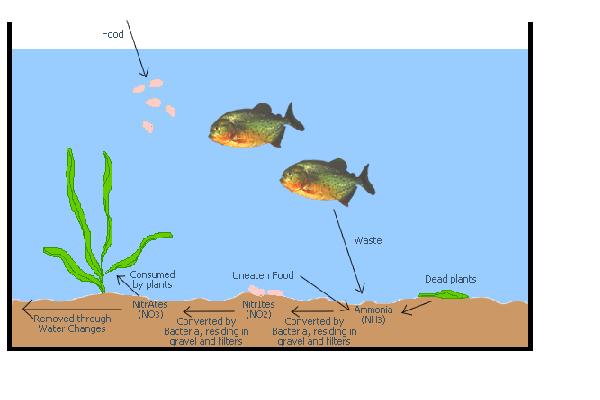
be cycled, or in other words: the nitrogen cycle needs to be
established.
This nitrogen cycle goes as followed: ammonia => nitrite
=> nitrate (see illustration).
First, you place the substrate in the tank, and fill the tank
with water. Depending on where you live, the water may contain chemicals that
are dangerous to fish, like chlorine, chloramine and metals. If so, the water
needs to be treated first. Besides that, the pH and hardness of the water has
to be changed according to the fish you want to keep (fish from the Amazon
region, for example, prefer soft, acidic water, and African Cichlids need hard,
alkaline water). After that, the 'aquatic hardware', like filters and heaters
should be installed, and started. After a few days, you can add the first
plants (very useful for a healthy tank environment, since they transform CO2 into oxygen, a
welcome and beneficial addition to the normal gas exchange between water and
air at the surface). Some days later a couple of cheap (feeder) fish (like
goldfish or minnows) should be released in the tank. Heavy feeding is not
necessary. The fish's waste, containing ammonia (a chemical substance very
dangerous to fish which, in high levels, can cause severe 'ammonia burns' and
damaged gills) will kick start the growth of the ammonia-consuming bacteria.
These useful bacteria will feed themselves on the ammonia, and release nitrites
into the water as a waste product. Nitrites is also very harmful to fish, but
are taken care of by other bacteria that transform it into less dangerous
nitrate. The start of these chemical processes can be accelerated by adding
bacteria cultures (or even pure ammonia), fish flakes or more fish to the tank
water and to the filter media, but this is not necessary, since it will happen
naturally between 3 to 6 weeks, depending on the tank's size. The final stage
in the chemical cycle is doing water changes: this will remove the nitrates
from the water. To keep track of the 'birth' of this cycle, perform water tests
on regular intervals to see if the water perimeters are going into the right
direction.
Tip: The cycling process can be shortened considerably when you use
filter media and, to a lesser extent, gravel and decor from an already
established tank.
When the tank is finally settled, which means ammonia and nitrite levels are
zero and the pH and water hardness are suitable for the fish you choose to
keep, it is time to introduce the piranha's into the tank...
The next couple of paragraphs are about how to set up the tank. Piranha's are
large and powerful predatory fish, but also have a skittish and nervous
character, and therefore the tank must be set up accordingly. Of course, the
final aquascaping should be done before the fish are released into their new
home, to minimize stress.
Aquascaping a piranha tank
The next thing I want to discuss is the aquascaping of a piranha
tank. Despite their fearsome reputation, piranha's are very skittish and shy
fish: they panic easily and sometimes without apparent reason, and this could
harm them when hiding next to the heater or slamming into rocks or other sharp
objects. For example: in fear, one of my own Redbellies once hid behind a
heater when I had to replant an uprooted plant. This gave him a couple of nasty
heater burns (see picture to the right), which fully healed after 2 months
however. What I am trying to point out here is: because piranha's are nervous
and frighten easily, accidents can happen. Most of the time the fish will
recover fully, but try to minimize the risks for your piranha's wellbeing.
Because piranha's are scared easily, they need a large tank
which an abundance of plants which they can use as hiding places. These hiding
places comfort your fish; they have the opportunity to hide when they feel it
is necessary, and in the long run they will be more at ease and more daring.
Besides that, pieces of bog wood or rocks are appreciated since they provide
additional shelter. When adding rocks to your setup, be sure the rocks do not
affect your water chemistry: limestone, marble, dolomite, calcareous
sandstones, and any soft, chalky rocks will make your water hard and alkaline,
which can be harmful to Amazonian fish. Dead or crushed coral and sea shells
will raise the pH of your tank water even more. Rocks that are suitable,
because they do not have effect on the waters chemical composition, include
granite, basalt, gneiss, slate and quartz. One last thing to remember about
using rocks: make sure that they do not have sharp edges, which might wound
your fish when running into it (like I said before: piranha's are skittish, and
will dart through your tank when scared, agitated or hunting!)
For bog wood or driftwood there are some points to consider as
well: before placing it into your tank, it must be boiled and cleaned
thoroughly until all tanic acids have leached out. Especially when you plan to
use wood found outside, be sure it is cleaned well, and that no resin, dirt
etc. remains.
Pieces of wood and rock are important for piranha's, because they provide
places to shelter and make the environment more natural. Piranha's (or at least
species from the genus Pygocentrus) are territorial fish, and big Ed has taken
residence under a piece of bog wood; it is an ideal place for him to check out
what happens in his surroundings inside the tank as well as outside of it. My
point is: provide shelters, and your piranha's will be more at ease and eventually
will become more daring and adventurous.
A very important thing to consider when setting up your tank is that, because
piranha's are such ferocious (and messy!) eaters, lots of waste and pieces of
food will stack up in the substrate. Waste will release harmful ammonia into
your tank, and besides that, decaying food will deprive your aquarium of
oxygen. A very powerful and efficient external (canister) filter or an sump is
an absolute necessity to deal with chemicals dissolved in the water: the
biological filter must be powerful enough to filter a tank of at least 1,5
times the size of the piranha tank, better 2 times (in other words, for a 100
gallon piranha aquarium, you'll need a filter rated for 150 gallons, but
preferably 200 gallons). Reliable and efficient external filters are made by
Eheim, Fluval, Magnum and AquaClear. Besides that, an additional internal
filter, mainly for mechanical filtration (ie. removing floating pieces of
debris, like dead plants) can be added to the tank. Another useful device is a
powerhead to create currents: most piranha's love to swim in it, and it is good
for their growth rate, because the exercise speeds up their metabolism.
Finally, an air pump will oxygenates the water and maximizes surface gas
exchange between air and water (CO2 vs. oxygen), because
it makes the water surface area larger.
The substrate can make a difference as well. A good substrate is a sandy one,
but a thick layer of very fine gravel (2-5 mm.) will do a good job as well.
Crude gravel is not recommended, because waste products, dead plants and
leftovers from feeding sessions get stuck between it, and will start to decay,
which will influence the water quality in negative way. A fine substrate on the
other hand will remain less polluted since the current caused by the pumps,
filters and bottom dwelling fish (like Catfish or Loaches) will flush
significant amounts of unwanted material into the filtration system.
Introducing some suitable catfish species, like Pleco's and Talking Catfish,
into your tank environment, might be helpful too. But this is risky method
which can be costly, because not all piranha's tolerate companions in their
tank. I return to this topic later on...
Another useful way to keep your water perimeters in check is using living plants
instead of fake plants (or none at all). Plants will absorb (harmful) chemicals
like CO2 and nitrates, and
help oxygenating the tank water during daytime (at night they do not absorb CO2, but instead release
it). Another reason why live plants are useful is that they use up all the
available nutrients in the water, depriving any algae from a food source.
Besides that, a nicely planted tank looks more natural than a very sterile
tank, but of course that's a matter of personal preference. Your fish will appreciate
it, though.
Piranha's do not like very bright light, because it makes them feel vulnerable,
and some even say it is harmful to their eyes, since they do not possess
eyelids to protect their eyes or retractable pupils to adjust their eyes to different
light conditions. And in their natural habitat, the water is often very murky
or mostly shaded by overhanging plants. The amount of light is of course
determined by the tank size, but in general, one standard, 36 Watt tube light
will be sufficient for a small to medium-sized tank (up to 80 gallon), two
tubes for larger tanks. You could even consider using no artificial light
whatsoever, but than make sure the tank is placed in a bright place, because
plants need light to grow and transform harmful chemicals (like nitrates) in
the water into oxygen. But when your tank is standing in full sun light, it can
cause an explosive growth of all kinds of algae, with all the nasty
consequences that accompany this. A good compromise is using tube light for the
plants and floating plants to provide shaded areas. Dimming the light with
sheets of paper, tinfoil etc. or painting or wrapping the light tubes to dim
them, are suitable solutions as well. Finally, an arched piece of wood, a rocky
cave or a flower pot, under which the fish can shelter, will also do the trick.
Piranha's are very tough fish that can adapt to various water conditions and
even survive in very dirty water, but it's (of course) best to provide them
optimal water conditions. The temperature of the tank water should be between
76-82° F (24-28° C), the pH ranging between 6.0 and 7.5. In their home range
(tropical Southamerican rivers) the water is fairly oxygen-poor, soft and
acidic, because of decaying plants and slow water current. This condition can
be simulated by running the tank water over peat (to be placed inside a filter)
or black water extract, which you can buy at most pet stores. But this is
absolutely no necessity!!!
Setting up an aquarium for piranha's is not as hard as it might seem, and as
long as you observe a few rules, you can make your piranha's feel at home
without too much effort. The most important thing when decorating the
environment were your beloved killers have to house for many years: listen to
what other, experienced piranha keepers have to say and use common sense, and
of course, your imagination!!!
After setting up the tank and cycling it properly, it's time to
introduce the piranha's into their new home. You'll notice they will most
likely vanish as soon as they touch water. Do not worry about this: they need
some time to acclimatize and cope with the stress of being moved around and
placed in unknown territory. Depending on the boldness of your new pets and the
way you furnished the tank, the newcomers will start to explore their new home
within hours, days or even weeks. Remember that it it's not sensible to start
feeding them right away, because they will most likely not touch it, and it
will start decaying. After a few days they should be calmed down a little, more
at ease and should start to swim around, exploring their new home, and make
more frequent appearances. But they will remain skittish, especially when
abrupt movements inside or near their tank occur, and (unfortunately) this
behavior will most likely never completely vanish, although my own Redbellies
are quite curious, especially when I approach their tank (they probably hope
for a nice meal...)
It is very important to watch your newly introduced fish closely the first days
and weeks. All the hassle concerning transporting (many piranha's, especially
the rarer species, are wild-caught, and shipped over long distances), moving
into a new tank and acclimatizing, can take a heavy toll from them. The stress
from being transported (especially with shipped fish, which are often
tranquilized and kept in small boxes for many hours), the relative sudden
change from transport water to tank water (no matter how gradually you
introduce the fish) and the completely strange and bewildering environment they
suddenly find themselves in, must be a terrifying experience. So monitor their
adjustment and acclimatization to their new home closely. Within a few days (or
weeks, in extreme cases), they must start to explore their new home, no matter
how careful they probably are, and accept some food. When they remain passive
or even lethargic, and/or refuse to eat, inform what is the best thing to do,
whether at a local pet store or on discussion boards on the Internet (see the link-section).
Piranha companions?
When the piranha's have acclimatized to their tank, you might
consider adding some other fish in their tank. The question in how far
piranha's can be kept together with non-piranha species is a much debated
subject. Some argue that it is impossible to do, others have successfully mixed
their piranha's with a variety of other fish species. I think it is all a
matter of how large the tank is, in which way it is aquascaped, the amount of
piranha's, what species of piranha, their attitude and character, how well-fed
they are etc. Personally, I do think that it is possible to mix certain species
of piranha (ie. Pygocentrus-species, Redbellied Piranha's in particular) with
other fish, as long as they can defend or hide themselves and the piranha's are
well fed. I used to have six, later five adult Redbellies of about 8-9"
(20-23cm.) in length, and they share their tank with a wide range of different
species, including Plecos, Corydoras, Neon and other Tetra's and small
Barb-species. Occasionally, one of them is eaten by the piranha's, but after
frequently visiting piranha discussion boards I realized that my situation
appears to be an exception rather than the norm. Some of the Barbs, placed in
the tank as feeder fish initially, have coexisted with the piranha's for years!
This is my personal experience, but there are numerous stories
from piranha-owners who are unable to have their piranha's live together with any
other animal. Many will say that the more aggressive species, like S. Rhombeus
and S. Elongatus (in fact, most of the solitary Serrasalmus-species) are
virtually impossible to mix with other fish, their own species included!
Others, like the Wimpel Piranha and other aggressive scale eating and
fin-nipping species, can only be kept with strong species larger than
themselves, because they eat fins and scales, and can damage a fish so bad it
eventually perishes. Omnivorous relatives on the other hand, like Silver
Dollars and Pacus can be kept together with a variety of other fish, including
small Tetras, Barbs etc, although Pacu's do eat smaller fish on rare occasions.
I have noticed that the most common fish accompanying piranha's are pleco's. It
is a useful bottom dwelling fish, because it is an active scavenger that cleans
up the bottom of the tank. Besides being useful, are pleco's very strong fish,
because of their armor plates, and their ability to withstand very poor water
conditions. This makes them more resistant to piranha bites and the waste
produced by the predators (fish waste, rotting food). They hold their ground
against too obtrusive piranha's by hitting them with their powerful tail or
bumping into them, but many have died by the 'hands' of piranha's as well.
Personally, I highly recommend this fish for being a very useful and hardy
companion for your piranha's, but it's important to buy your pleco together
with the piranha's, or buy a larger one once you decide to do it in a later
stage of your hobby.
Other animals that can help keeping your substrate tidy are talking catfish
(because they are nocturnal and hide out of reach), crayfish and crabs (very
vulnerable when molting, so provide enough hiding places) and snails. They all
do a good job, but results vary, ranging from successful to almost instant
death..... Piranha's are opportunistic predators, and you simply cannot know
how they will react to other animals in their tank. It's not uncommon with
piranha's that they kill a tank mate that has lived with them for several
months.
When you finally have your tank furnished, running and
populated, it's time to sit back, relax and enjoy the fruits of your labor. The
most laborious part of the aquarium hobby, setting up a tank, is now a thing of
the past, but that does not mean you can sit back and let he fish fend for
themselves. A tank has to be maintained properly to keep its inhabitants
healthy and happy. But tank maintenance is not as laborious as it may sound:
depending on its size and inhabitants, it averages about one to two hour a
week, although most piranha keepers spend a lot more time on taking care of
their fish.
When keeping piranha's, the most important thing is to keep the water clean.
You should run water tests every so many days or weeks. Changing about 20-25%
of the tank water every week is an absolute necessity, but around 50% every
week is recommended in order to keep the fish healthy and growing/developing
without incident. Changing too much water (more than 75%, in my opinion) is not
recommended though, because it may cause the water perimeters to change very
abruptly, which may kill or disease the fish. Furthermore, make sure that you
always remove uneaten food items and dead plants, vacuum the bottom of the tank
every once in a while, using a battery-operated aquarium cleaner, python system
or a piece of filter hose, to get rid of waste.
The filtration system should be cleaned every few months: a general rule of
thumb cleaning it as soon as the filter throughput starts to decrease, but this
is not the safest rule. Performing water tests is a more reliable manner: when
peaks occur (more frequently), it is time to clean/refresh the filter media.
When cleaning a filter, be careful not to clean the filter media containing the
nitrifying bacteria too much (they must be kept in warm water, preferably
flowing water, to maintain a steady flow of oxygen and nutrients), because you
can easily kill the bacteria that inhabit the media. In a worst case scenario,
your tank might become inhabitable for fish and has to be cycled again. The
best way is rinsing half of it with warm (not hot!) water, and the rest a month
or so later. The media containing the bacteria must remain wet as well: the
bacteria die after they are out of the water for about 10 minutes. Filter media
(like active carbon, zeolite, media bags, peat pellets or peat moss) and filter
pads can be washed out every time you clean your filter, and replaced every
third filter cleaning session.
Additionally, undesired algae growth needs to be removed from the aquarium: the
tank walls can be cleaned with a magnetic algae scraper, pieces of decor can be
brushed clean with a tooth brush or something similar (preferably outside the
aquarium), and plants leafs can be rubbed clean with your fingers. Probably
unnecessary to mention: never ever use chemical cleaning products!
And in my opinion the most important (and enjoyable!) of it all: observe,
observe, observe! The more you watch your fish, the more you will learn about
them and their behavior and needs, and the easier it is to spot irregularities
or problems in an early stage. By constant close observation, your
ever-increasing knowledge of your fish will allow you more time to take
appropriate and effective measures (and this ground rule applies not only to
piranha's, but to all aquarium fish, and in fact all pet animals).